







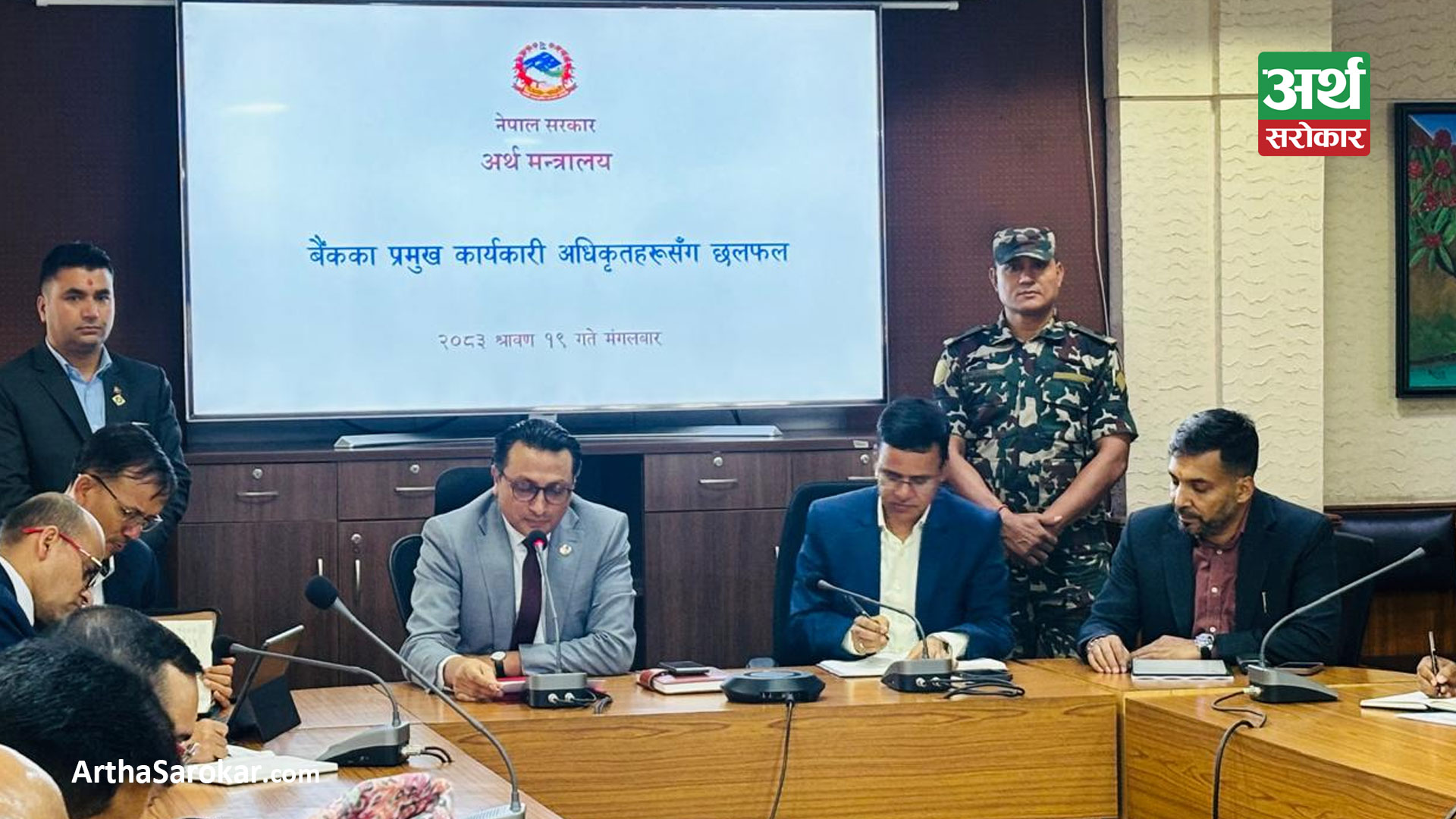
Kathmandu. Finance Minister Dr. Swarnim Wagle held a meeting with the Chief Executive Officers (CEOs) of commercial banks. On Tuesday, Wagle discussed the role of major financial institutions in the implementation of economic reform measures announced in the budget and the current situation of financial markets.
CEOs of 20 commercial banks participated in the meeting.
Finance Minister Dr. On the occasion, Wagle discussed the economy, role of banks and financial institutions and measures for economic reforms. This is the discussion of Dr. Written address by Wagle:
Today’
s meeting is not just a formal discussion, it is another step in a common campaign to revive Nepal’s economy. After an intense dialogue with the private entrepreneurs, today we are sitting with you who are leading the financial system. Because the banking system is at the center of production, investment, savings, financial confidence and economic activity.
In fact, commercial banks are the most important confluence of the economy. Savers, entrepreneurs, farmers, industrialists, investors and youths who want to start a new business also come here. Therefore, you are the ones who most clearly understand the real psychology of the economy, the confidence of the market, the thinking of the investors and the expectations for the future.
Through the budget, we have set a clear direction for Nepal’s economic transformation. Now our focus is on implementation. Therefore, today I have come to listen to your experiences and suggestions to solve the problems seen in the economy along with the implementation of the budget.
We all have the same goal – to make Nepal’s economy dynamic again. Increase investment. Expand production. Creating jobs. and restoring the confidence of the private sector. On behalf of the government, we are forwarding the process of regulatory, legal and institutional reforms. But one question we need to ask ourselves is: Are these reforms enough? What else should be done’
Today, I particularly want an open and frank discussion on this issue.
What is the psychology of Nepal’s economy today? Why are businessmen reluctant to expand? Why has the demand for loans not increased even when interest rates are historically low? Why has the excess liquidity in the banking system not been converted into production and investment? Does the solution lie in monetary policy, fiscal policy, or private sector confidence?
What structural reforms are needed to increase the flow of credit to the productive sector of the banking system? What new approach should be adopted in monetary policy, regulation and supervision? How can the coordination between the Ministry of Finance, Nepal Rastra Bank and the banking sector be made more effective?
I want your clear and frank views on these issues.
Today’s discussion will not be limited to identifying the problem alone. We want to move ahead with solutions, timelines and responsibility. Where there is a need for legal reform, we will reform the law. Where there is a procedural problem, we will change the process. We will coordinate where institutional coordination is needed. We will not shy away from taking decisions where it is necessary from the government.
We want to make the economy self-confident, decisive and optimistic about the future, not in a reactive manner. Therefore, let us take today’s meeting not as a periodic dialogue with the banking sector, but as a workshop to make Nepal’s financial system a leading partner in economic transformation.
I want to make one thing clear: the relationship between the government and the banking sector is not only that of regulatory and regulatory bodies, but also of common national responsibility. Economic growth, investment expansion, job creation and financial stability are our common objectives. Therefore, today’s recommendations will not be limited to just discussions: we are committed to translating them into a clear roadmap for implementation.
We all share the same agenda: build trust, expand investment, increase production and usher Nepal into a new phase of high growth and high productivity.
Let’s have an open discussion on the problem and find a solution. Let us draw actionable conclusions from today’s dialogue.
Thank you.

Leave your comment