




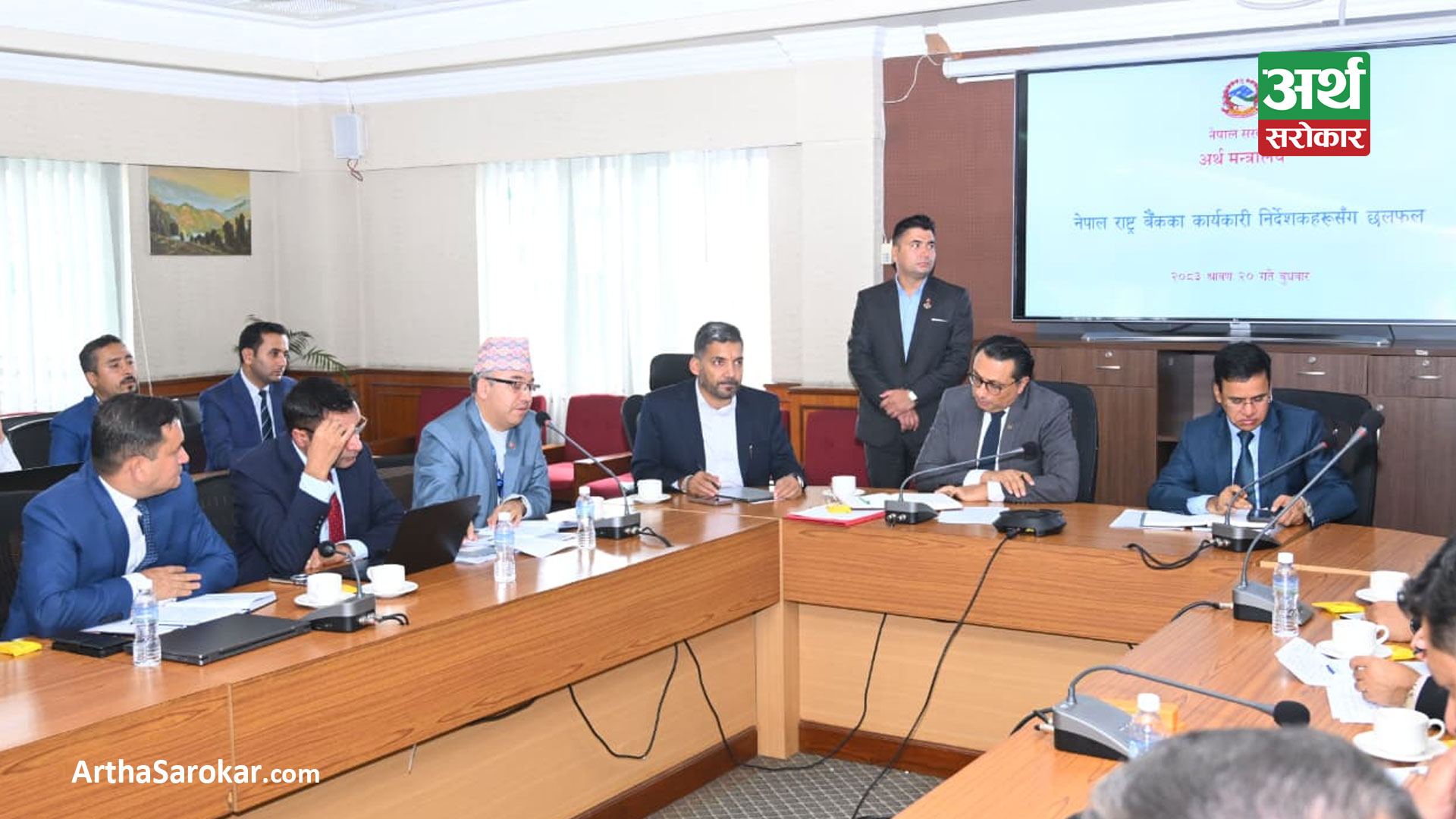
Kathmandu. Finance Minister Dr. Swarnim Wagle held discussions with the Executive Directors of Nepal Rastra Bank and . The Finance Minister held a meeting with the executive directors of the Nepal Rastra Bank at the Subarna Hall of the Ministry of Finance in Singha Durbar on Wednesday.
In the discussion, Finance Minister Wagle said that the government is moving ahead with a clear ‘roadmap’ and that it is not ‘possible’ but ‘what should be done to make it possible?’
Similarly, during the meeting between the Executive Directors of the Nation Bank and the Finance Minister, the liquidity management in the banking system, measures for economic reform, production, employment and capital markets, real estate, banking system and the real economy were discussed ।
What did the Finance Minister say to the directors of the bank in the discussion?
Respected Executive Directors,
I warmly welcome all of you.
Today’s meeting is not only a regular inter-institutional coordination meeting but also an important step in the common campaign to implement Nepal’s economic transformation.
In the last few days, I have had the opportunity to have a long discussion with the CEOs of businessmen and commercial banks.One thing that has become very clear from these two meetings is that the private sector is now looking for more confidence with new opportunities. They don’t just want concessions, they need clear policies, stable rules, quick decisions and credible implementation.
In this context, today I am sitting with you . Our thinking, our priorities and our performance should be oriented in the same direction.
We need to look back at the last decade. Haven’t we made the right policy decisions? We were able to do it in many places. But why did these decisions not yield the expected results when they were implemented? Why has the private sector become increasingly defensive? Why did investment confidence weaken? Why did liquidity increase in the banks but the credit could not reach the industry? Why is the relationship between the capital market and the real economy weakening? Why did production and productivity not pick up the expected pace?
These questions are not just a subject for review. The answers to these questions will determine the economic policy of the next decade.
The government has set a clear direction through this year’s budget.This is not a normal annual budget. It is a roadmap for economic reform and structural transformation.
Now the question is – ‘How does Nepal Rashtra Bank redefine its role in this journey?’
Today I want an open and serious discussion on this topic. We all need to ask our own organizations a question: “Are we working with enough confidence? Do we have enough policy clarity? Is there enough urgency in our decision-making process? Are we the regulator to solve the problem, or the regulator to manage the problem? Should we look at the current economic situation only from the point of view of risk management or from the perspective of opportunity creation?
Today, I would like to hear your views on some topics in particular.
What policy initiatives should the Nepal Rashtra Bank take to make the economic reforms announced by the government a success? How can credit flow be increased in the production-oriented sector? How can the excess liquidity in the banking system be converted into production, industry and employment? How can we build a healthy relationship between the capital market, real estate, the banking system and the real economy? How to make the coordination between monetary policy and fiscal policy more effective? How to facilitate digital finance, fintech, alternative finance, startup financing and new financial instruments?
The purpose of regulation is not only to control, but also to enable productive economic activity.Are our regulations stifling or encouraging innovation? This is also the question we need to ask ourselves.
Today I would like to make a special request – let us discuss not from the thinking of ‘this is not possible’, but from the thinking of ‘what should be done to make this possible?’. Because what Nepal needs most now is policy confidence.
If the government is confident, Nepal is confident bank is confident, banking system is confident and the private sector is confident, then economic growth is not a very distant goal.
On behalf of the government, we have clearly taken our responsibility. The process of reform has already begun. We are expediting necessary legal amendments, institutional reforms and implementation. Now, the same momentum, the same clarity and the same commitment is needed from the monetary side. I would like to see Nepal Rastra Bank not just as a regulatory body, but as a partner and co-creator of Nepal’s economic transformation. Today’s discussion will not be limited to any formal comment. Every issue raised here will be converted into an action plan. If necessary, we will form a joint task force, institutionalize policy coordination, and make the decision-making process more efficient.
Finally, I want to say the same thing.
We have a rare opportunity now. There is a political will for reform. It has become the basis of economic stability. The private sector is ready for the opportunity. Now, the institutions of the state should also move forward with the same confidence, the same clarity and the same speed. If the government, Nepal Rastra Bank, banking sector and private sector move in the same direction, Nepal’s economic transformation will no longer be just a fantasy, it will enter the phase of implementation.
Let’s make today’s meeting another important beginning of that shared journey.
Thank you.



Leave your comment