







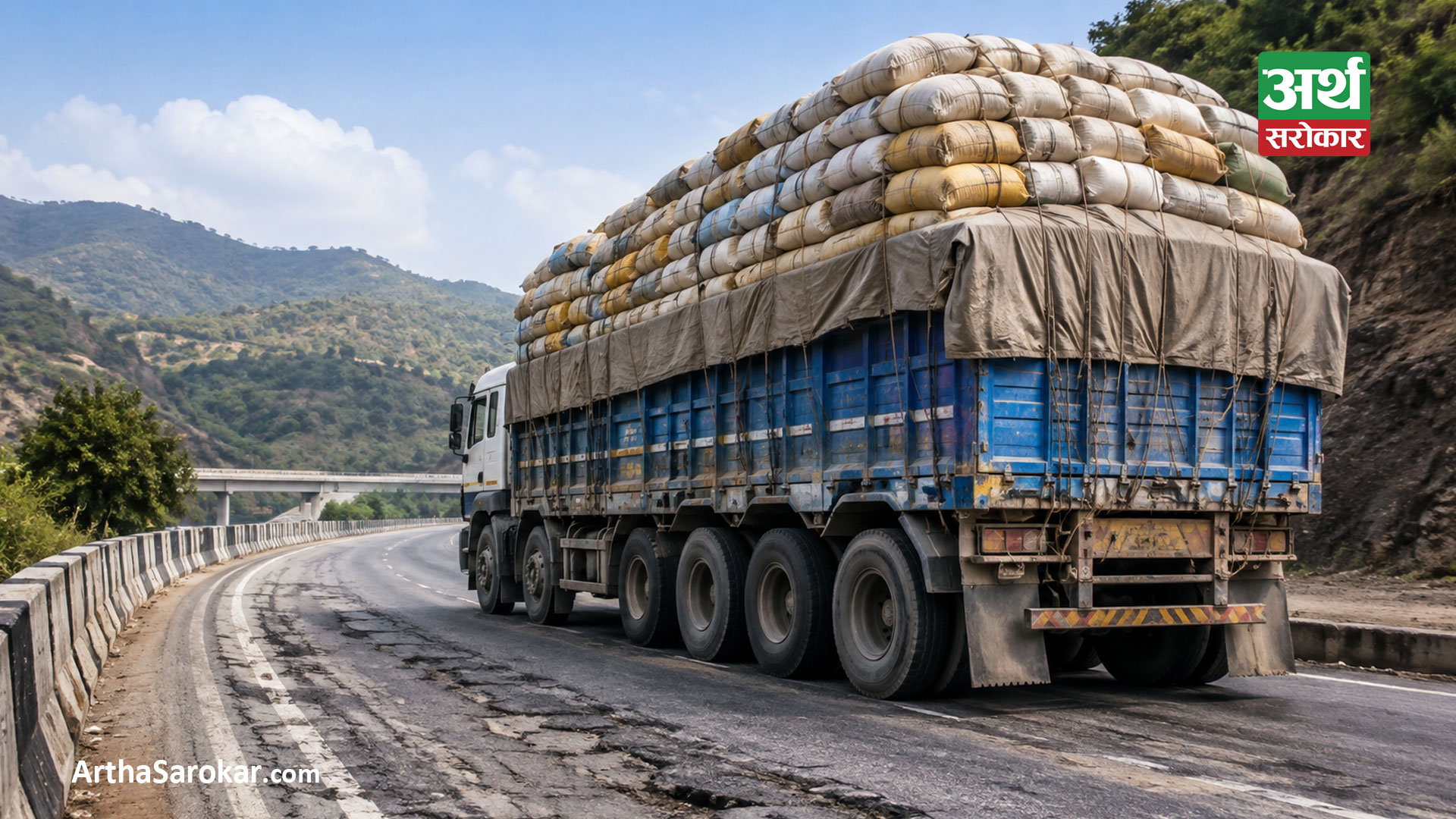
Kathmandu. The government is preparing to strictly enforce the provision of keeping the load-bearing capacity of the cargo vehicles within the legal ambit for the long-term protection of roads and bridges. The overload carried by the goods vehicles has caused potholes on the road, the road surface getting pressed and the bridges have been damaged. The government is going to enact a law to fine five lakh rupees to the goods vehicles carrying more than the capacity.
The proposed Public Roads Bill proposes to impose afine of up to five lakh rupees on the vehicle owners for carrying moreload than the limit specified in the bill. Clause 13 of the bill provides for the burden of goods vehicles and the penalty of .
National Planning Commission (NPC) member Arjun Jung Thapa accused the goods carriers of carrying excessive load and damaging roads and bridges.According to him, it is necessary to follow the load bearing limit set by the law to make the roads constructed with the investment of billions of rupees of the state durable. According to him, the cost of construction of four-lane roads is between Rs 25 crore and Rs 3 00 million per kilometer.He said that it was the government’s obligation to control the vehicles carrying more than their capacity causing damage on the road.
According to him, the load on each axle of should be kept within the legal limit . He said that some people have also created the illusion that only 10 tons of goods can be carried in a truck.
A truck can carry 100 tons of goods, but the weight of the truck on the road from the axle has to be 10.2 tons, he said. He said that the law does not prohibit the transportation of large quantities of goods using trucks with many axles. A truck can carry up to 100 tons of goods, but the weight of a single a xle should not exceed 10.2 tons, he said. According to him, in some countries of Europe, the ax le load limit is only 8.2 tons.
He said that the problem of one-way lane of the road on the main road is more difficult as the goods vehicles are carrying more goods than their capacity.He said that the road was buried in the lane entering Kathmandu on the Kathmandu- Birgunj road corridor and ‘Corrugation’ was seen on the surface.According to him, the problem of road subsidence has been seen in some places along the Butwal-Narayangadh road road. Corrugation will develop especially due to slow movement and heavy loads on the uphill slopes.
However, the truckers have expressed dissatisfaction over the fine proposed in the bill. The Federation of Truck Transport Entrepreneurs of Nepal (FNTE) has demanded amendment to the fine system. Although mandatory weight test, weight limitation and protection of road structures are necessary, the fine of up to five lakh rupees is exorbitant, according to entrepreneurs. However, NHRC member Thapa said that the proposed fine should be paid to the trucks plying within the limit. According to him, several bridges were damaged and some bridges collapsed due to heavy loads in the past. According to him, the bridges over Binayi River, Mukunda Khola, Baula Khola and Jayashree Khola have been damaged and some bridges have been broken down. According to him, a fine of Rs 68 lakh has been recovered from the concerned party after the bridge collapsed, but it will cost around Rs 100 million for the reconstruction of the bridge.
He said that if the goods need to be brought more than the capacity of , they can be brought with approval. He said that there will be no fine for the vehicles brought with approval. He said that special arrangements could be made to transport non-breakable equipment such as transformers and turbines of hydropower projects. For this, permission has to be taken from the Department of Roads or the concerned provincial government and the transportation can be done by making additional security arrangements as per the capacity of the roads and bridges at the required places, he said. He said that vehicles can be operated by constructing temporary diversions, providing additional supports under the bridge or improving the modes if there is a weak bridge. The cost of such additional infrastructure and security arrangements will have to be borne by the concerned project or entrepreneur transporting the goods.



Leave your comment