







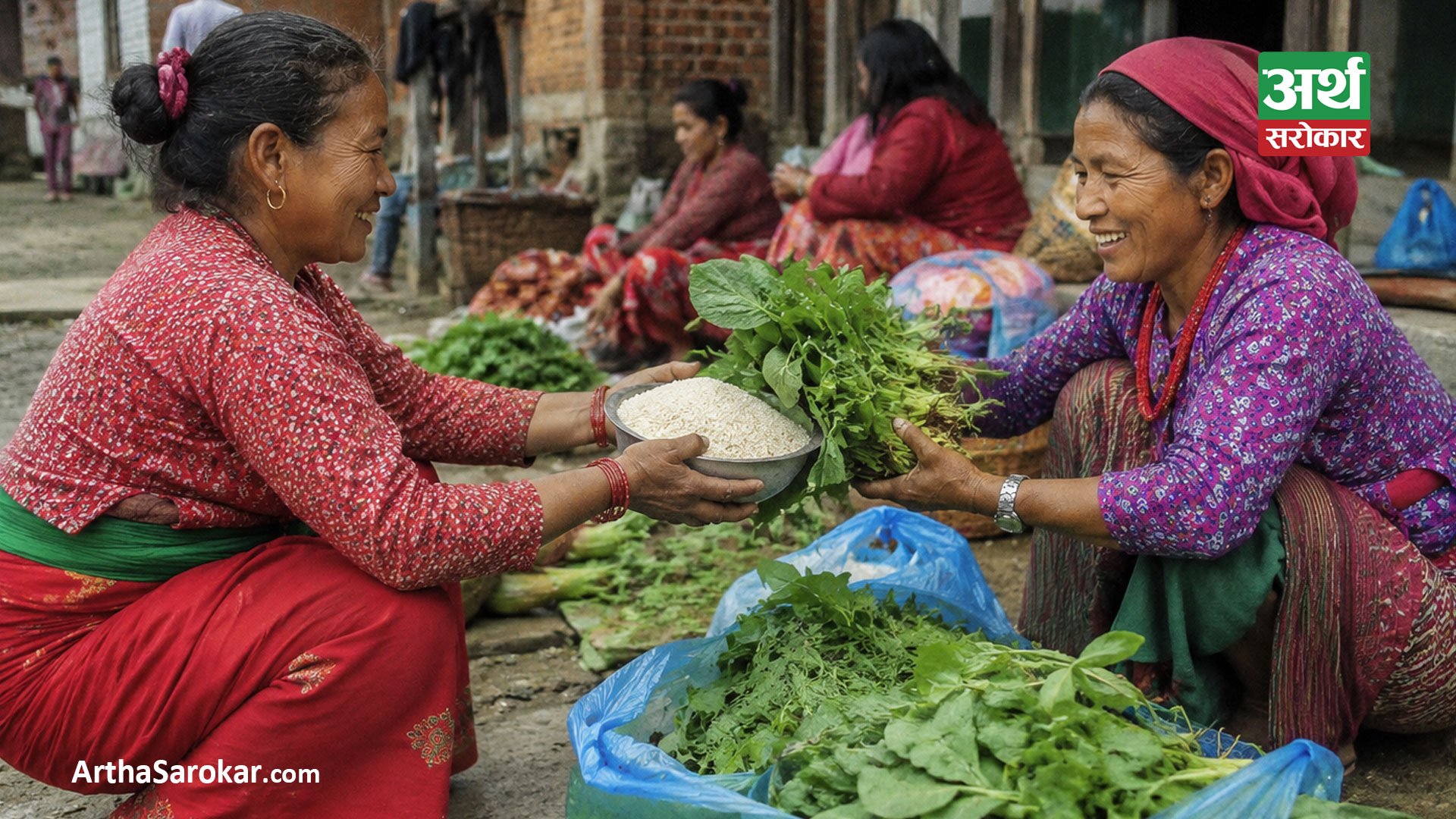
Kathmandu. Meena Chaudhary, a resident of Pipaladi in Shuklaphanta Municipality-3 of Kanchanpur, reaches the village early in the morning carrying a basket of vegetables on her head. But she doesn’t sell vegetables in cash. She shares wheat and other vegetables with farmers in her village, including beans, cucumbers, okra, bottle gourd, beans, bitter gourd.
“Since it is the wheat season, we exchange vegetables with wheat and also with paddy during the paddy season. “We give one weight of vegetables equivalent to two weights of wheat, it is more beneficial to exchange it with grain than cash,” she said. ’
According to him, the work of picking vegetables from the fields in the evening, cleaning them, putting them in baskets and exchanging them with the grains is done almost every day. With the increasing demand for fresh vegetables in the villages, women carry 20 to 35 kg of vegetables in baskets and take them to sell. She says that after exchanging grains with vegetables, the burden is doubled when she returns, so she has to call her family members to carry the grains.
The practice of exchanging grains with vegetables in rural areas of Kanchanpur is not new. According to Mangal Bahadur Chaudhary of Laljhadi Rural Municipality-4, this tradition is very old. “Earlier, when there was less access to cash, there was a practice of exchanging goods in the villages. She said, “Although the market and access to technology have increased now, this practice still exists in the village.” ’
Especially in rural areas, most of the families depend on agriculture, so food is available according to the season. That is why farmers are more likely to buy vegetables by paying grain than cash. The farmers get double benefit by exchanging vegetables with grains. On the one hand, families cultivating vegetables can raise food for the whole year, while on the other hand, they can also earn cash by selling them in the market. Currently, vegetables are being sold at Rs 20 to Rs 50 per kg while wheat is being sold at Rs 40 to Rs 42 per kg.
Ganga Chaudhary of Pipaladi said vegetable farming has become an important source of income for farmers with limited land. “We manage household expenses by exchanging the produced vegetables with grains and earn cash by selling the rest in the market. “My mother-in-law used to sell vegetables in the same way and this practice is still alive in rural areas,” she said. ’
Although men are involved in vegetable production, the role of women is more seen in vegetable care, controlling pests, picking and selling in the villages. It highlights both the economic activism and family responsibilities of rural women.



Leave your comment