




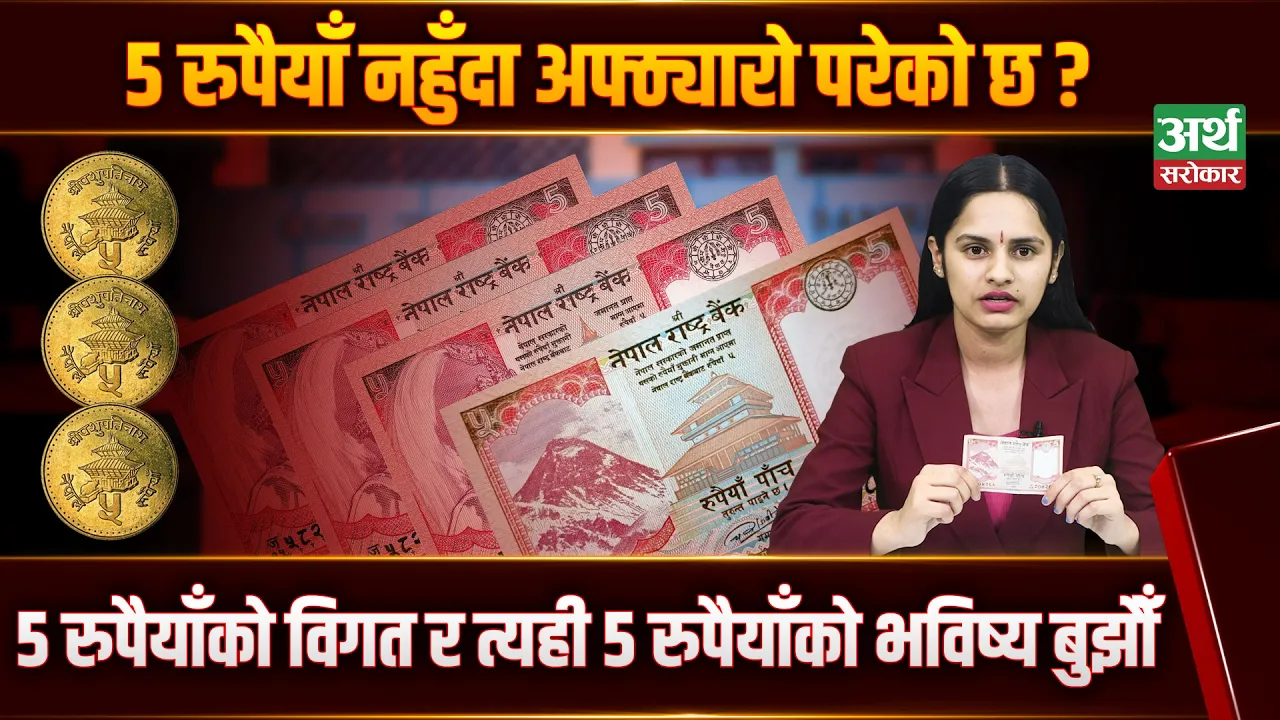
Kathmandu. The five-rupee note is one of the smallest denomination notes in Nepal. And this note is still in circulation and is used in small businesses across the country. The use of Rs 5 notes in Nepal is believed to have started historically around 1945 (2002 BS). Between 1945 and 1955, the first notes issued by Sadar Muluki Khana included 5 rupees.
The Rs 5 notes currently in circulation depict Sagarmatha, Pashupatinath Temple, Taleju Bhawani Temple and yaks at different times.
This denomination note was first issued in Nepal during the monarchy, which included a portrait of the king. Later, after the end of the monarchy in Nepal, the Nepal Rastra Bank issued a new series, in which the image of the king was removed and national symbols and cultural symbols were included.
The Nepali 5 rupee note is a small denomination currency issued by the Nepal Rastra Bank. Which we are using daily as a small shop and as a separate money. The note has a picture of Mount Everest and national emblems on the obverse, while the reverse has a picture of yak animals found in the mountains. During the monarchy in Nepal, the picture of King Birendra was displayed on such notes. But after Nepal became a republic in 2065 BS, the design of the notes was changed and the image of the king was removed. Instead, the country’s natural heritage, wildlife and cultural symbols have been given priority.
The 5 rupee coin was also in circulation at one time, but now its use has become much less and the notes are more in circulation. Although its value is small, this note is useful in the basic transactions of the Nepalese economy and is used in the daily life of the common people.
The importance of 5 rupees is a lot. Even today, five rupees are used in temple donations, worship, or religious activities. It is also widely used as an offering of Rs 5. It has more cultural and emotional significance than economic value. Although five Nepali rupees may seem small, it has its own significance. It is not just a coin or note, but an important part of our daily lives.
Five rupees helps to meet small needs. Even the school-going children say that they will eat chocolate, buy ribbons, chewing gum, and buy pencils to write.
Now let’s know what comes in 5 rupees?
What will you get for 5 rupees these days? My answer to those who say this is that there is a lot of talk in 5 rupees. For example, we can also buy chocolates, biscuits, kulfi and other things for 5 rupees. You can also get decoration items for five rupees. In the market, we can find ribbons, threads, hair forks, tops and other small items for 5 rupees.
On the other hand, small school-going children are seen asking for 5 rupees in the morning and evening in our society. Sometimes we laugh when we hear their little desires and fun wishes. But for these children, the price of 5 rupees is very big, because with that small amount, their small happiness is fulfilled.
Children’s thinking is simple and innocent. They don’t need very expensive things, they are looking for happiness in small amounts. Snacks like chocolates, biscuits, kulfi available for Rs 5 in shops on the way to school make their day fun.
Similarly, items such as a 5-rupee tika, small toys, or ribbons hold special significance for them. Even if they are small things, they bring great happiness to their hearts. They enjoy sharing with friends, eating, sharing, or showing off. It deepens their friendship and makes their childhood more colourful. Therefore, even five rupees plays a big role in every person’s life.



Leave your comment