





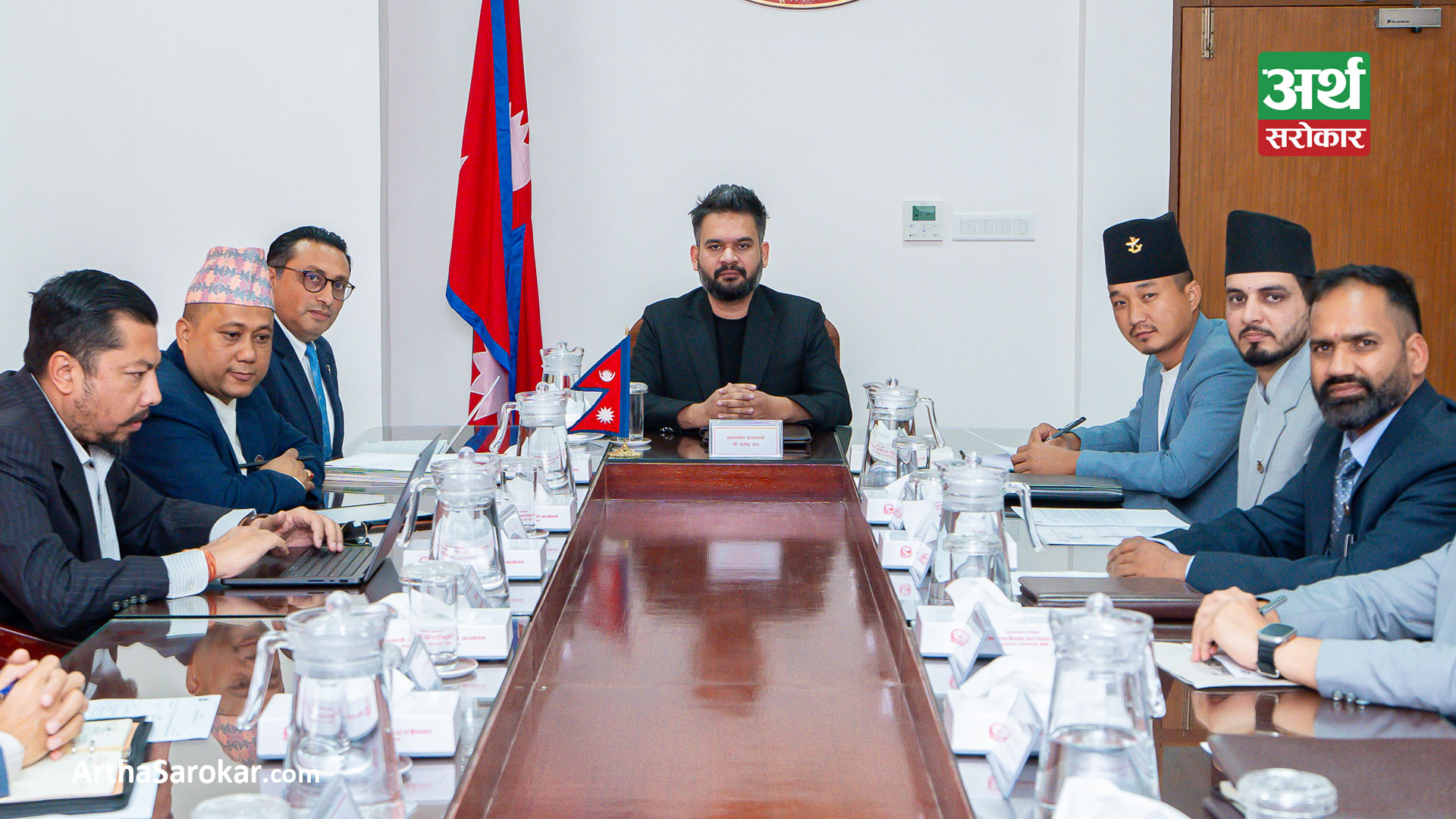
Kathmandu. The government has given high priority to policy reforms and legal provisions for the improvement of the country’s economy. On the occasion of 100 days of the formation of the present government, 15 irrelevant laws have been repealed as per the recommendations of the High Level Economic Reform Advisory Commission.
Similarly, the Department of Revenue Investigation has been dissolved and it has been managed.
With the objective of attracting private sector and foreign investment in public infrastructure development, the Alternative Development Finance Act-2083 BS has been passed by the Federal Parliament and has entered the implementation phase.
This has created an environment where innovative equipment can be used to mobilize investment in the priority areas of the state. Likewise, the Finance Procedures and Financial Accountability Regulations have been amended and the authority has been delegated to the Secretary (Accounts Responsible Officer) of the concerned ministry to transfer the amount of capital budget. The government believes that this will significantly reduce the process of transfer of funds and increase capital expenditure.
Arrangements have been made to enable taxpayers to avail services from the Office of Company Registrar and 120 local levels with permanent account number.
In view of the disruption in the supply of petroleum products due to the conflict in West Asia and price hike in the world market, 50 percent discount was given on customs duty and infrastructure development fees in order to reduce the burden on the people. Arrangements have been made to verify the pension from any place or home by implementing the ‘e-pension verification’ system. This has provided relief to a large number of pensioners.
Similarly, the Inland Revenue Office has provided all the tasks including submission of tax details, tax payment and other works through ‘online’ system.
It has been provided for reducing the cost of trade, facilitating trade and developing a ‘faceless and contactless’ revenue administration. Nepal has been included in the ‘Grey List’ of the Financial Action Task Force since February 22, 2081. For the first time, it has been on the grey list. It has made it clear that the present government is making progress due to the positive steps taken by the government.
The task force meeting in June 2026 evaluated the progress made up to April 2026 and upgraded three of the 15 tasks earmarked for the grey list to be completed and four to be partially progressed.
The final report has been prepared as per the due diligence audit (DDA) of Gorakhkali Rubber Industry, Hetauda Cement, Janakpur Cigarettes and Nepal Metal Company Limited.
Similarly, the final draft of the DDA of Udayapur Cement has also been received. Butwal yarn and ‘Nepal Oriental Magnesite’ are being studied. The study of the investment structure of 970 big and important projects under the Investment Board has been completed.
Likewise, the government has forwarded the process for necessary amendment to the Bank and Financial Institutions Act, 2073 BS to implement the provision of mobilizing funds in the accounts of banks and financial institutions that have remained inactive for 10 years or more.
According to the public details, a task force has been formed with representation from the Ministry of Finance and the Ministry of Law, Justice and Parliamentary Affairs and submitted the draft report to the Board of Directors.
The Financial Comptroller General’s Office has prepared a study report for the unification of the fund within a hundred days and submitted it to the Ministry of Finance.
There is a total of Rs 84.84 billion in deposits in more than 196 funds. In order to control revenue leakage, the Department of Revenue Investigation (DRI) has been scrapped and its functions will be merged under the Inland Revenue Department and the Department of Customs.
A dedicated operation team has been formed and mobilized to control revenue leakage. In a bid to control revenue leakage and make tax administration transparent, 841 taxpayers with annual turnover of more than Rs 200 million have been brought to the Central Invoice Monitoring System.
Likewise, a circular has also been issued to bring taxpayers with a turnover of more than Rs 100 million into the system from June 15. A total of 253 monitoring teams have been mobilized to ensure mandatory implementation of MRP in the market. Under this, 1,692 companies and firms were monitored and 102 were fined Rs 7.116 million. The vehicles parked at the customs point for years have been handed over to the Nepal Police and other bodies and the process of auctioning the remaining vehicles has been initiated.
It is stated in the public details that the government has ruthlessly suspended and investigated the employees and people involved in the revenue leakage at the customs checkpoint.
Core drilling has been carried out at 12 places in course of detailed feasibility study at Dhauwadi and Rate Khola iron mines. Approval in principle has been received from the Department of Mines and Geology for the excavation. In addition, environmental impact assessment (EIA) has been initiated through consultants.
Similarly, policy reforms have been implemented to limit the multi-approval level in the government decision-making process to a maximum of three levels.
Mining and regulation of mines and minerals in different parts of Nepal has been tightened. Under this, clarification has been sought for 27 inactive licenses. Similarly, three exploration permits and 122 exploration permits have been canceled. The government has given approval to the Nepal Army to produce test production on a small scale in order to restart the Hetauda Textile Factory. An estimated cost of Rs 50 lakh has been prepared and submitted for the maintenance of physical infrastructure of the industry.
Likewise, a preliminary study has confirmed that there are 112.1 billion cubic meters of natural gas reserves in Jaljale area of Dailekh. A theoretical basis has been prepared for the feasibility of producing 200 MW of electricity, 2,200 tons of urea fertilizer daily and CNG÷PNG as motor fuel through the use of this hydropower. The major challenge of the project is to manage large scale investment and develop basic infrastructures including roads, electricity and drinking water required for commercial excavation of said resources.
Priority has been given to determining the modality of investment by establishing a subsidiary company of Nepal Oil Corporation, formulating national standards and collaborating with universities for the development of technical human resources. An action plan has been prepared to advance the project in a phased and systematic manner by expediting the detailed technical and economic feasibility study.
In order to provide integrated services to the investors, a ‘one-door approval system’ has been established and fully operated under the Investment Board Nepal. A strategy has been formulated for the protection and promotion of the private sector to boost the morale of the private sector.
Bilateral talks on signing a double taxation exemption agreement with the United Kingdom and negotiations with the United Arab Emirates (UAE) have been initiated.
The implementation of international tax and financial transparency standards has been initiated. It is included in the public information that the ‘Transfer Pricing’ directive has been issued and the legal provisions in the Finance Bill, 2083 have been made in this regard.
Additional powers have been delegated to representatives of 14 different agencies based in the one-stop service centre operated by the Department of Industry. The employees deputed at the Single Stop Service Center of the Department of Industry have been delegated authority to issue tax registration certificate from the tax officer.
The concept paper of the Rapid Response Mechanism for Strengthening Industrial and Occupational Safety has been approved. A total of 15,439 Armed Police Force teams have been kept on standby for emergency situations in all 77 districts. Arrangements have been made to set up the District Industrial Commercial Security Coordination Committee.
Relief, tax, exemption, concessions and other monetary facilities have been provided to the industries, trades, business establishments and economic activities affected by the Genji movement by preparing an integrated business revival plan. The Nepal Rastra Bank (NRB) can reschedule and restructure loans given to industries, trades, businesses, establishments and other borrowers directly affected by the extraordinary situation created during the Zenji movement.
The minimum stock in the national food store has been maintained at 8,000 metric tonnes and 25,000 metric tonnes respectively.



Leave your comment