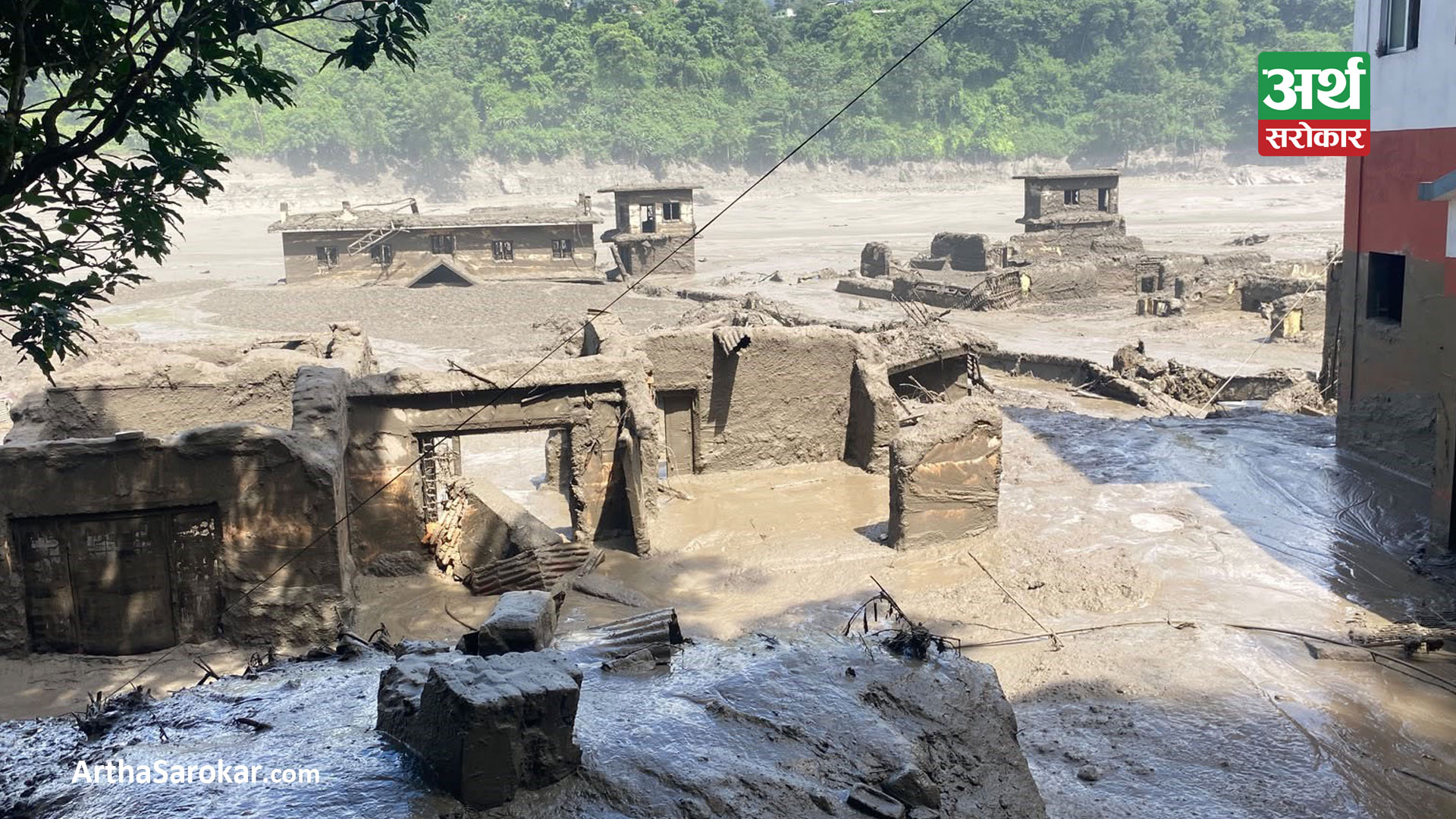





Kathmandu. The devastating floods in the Rasuwa-Bhotekoshi River on August 26, 2008 caused a loss of Rs 79.17 billion, according to preliminary estimates. According to a survey conducted by the National Planning Commission, the floods caused a loss of Rs 69.57 billion to households and Rs 9.60 billion to businesses and establishments.
The floods have affected 6,817 households and 499 businesses and establishments in 4 districts. The affected population is 32,872 and 2,989 residential structures have been completely damaged.
According to the preliminary information received in the survey, Nuwakot has been the most affected by the floods. In Nuwakot, 3,841 households have been affected. Similarly, 1,920 households in Rasuwa, 948 in Dhading and 108 in Gorkha have been affected.
Most damage to land
According to the details of the economic damage, the biggest damage caused by the floods was on the land. According to the preliminary data of the survey, 507.97 hectares of land belonging to 3,610 families was damaged and the preliminary assessment was Rs 35.44 billion.
The loss has been estimated at Rs 13.26 billion on land owned by the house and Rs 11.95 billion in the cost of house construction. This shows that the economic damage is widespread from the loss of land due to floods to the families whose houses have been completely destroyed.
A total of 2,989 residential structures have been completely damaged by the floods. Out of a total of 4,151 damaged buildings, 3,194 are unusable. 332 structures are in a state of complete repair, 320 after general maintenance and 97 structures are in unusable condition.
Damage to crops, livestock and vehicles
The floods have not only affected the land but also the agricultural production and the livelihood of the family. The crops planted in the fields have been damaged to the tune of Rs 23.21 crore. As many as 2,951 families have been affected.
According to the preliminary data, there was a loss of Rs 10.41 crore in food items and Rs 21.42 crore on livestock and fish. As many as 1,876 families were affected due to damage to food items and 1,011 families were affected due to damage to livestock and fish. Vehicles used by families have been damaged to the tune of Rs 1.24 billion. As many as 1,115 families have been affected. Similarly, valuable, cultural and archaeological items have been damaged to the tune of Rs 5.02 billion, the report said.
Household appliances of durable nature have suffered a loss of Rs 1.45 billion while non-durable household appliances have suffered a loss of Rs 663.5 million.
Trade and food service sector most affected
Wholesale and retail trade have been the most affected by the floods in the sectoral details of businesses and establishments. As many as 774 enterprises have been affected in the region, which is 47.25 per cent of the enterprises covered in the sectoral data.
337 establishments in the housing and food service sector have been affected. This is 20.57 percent of the total. It is reported that 166 establishments in the agriculture, forestry and fisheries sector and 136 other service sectors have been affected.
As many as 70 establishments in the industrial production sector, 47 in the construction sector and 31 in the transport and storage sectors have been affected. Apart from this, financial services, mines and exploration, communication, education and health sectors have also been affected. According to the district-wise data, 323 businesses and establishments in Nuwakot, 104 in Dhading, 57 in Rasuwa and 15 in Gorkha have been affected. However, the total number of establishments in the sectoral data is 1,638, so more clarity is needed in the business-related data.
More than half of the families are in favor of government rehabilitation
After the floods, the choice of the affected families in terms of where to live permanently shows the challenge of rehabilitation. The preliminary data of the survey included the choice of 3,067 families.
Of these, 797 families (25.99 per cent) have said they want to return to the place where they were living before the floods. There are 565 families who want to live in other places within the district owned by the family and 159 families who want to live on their own land in other parts of the country. The number of families who want to live in the places provided by the government is 939 (30.62 per cent). Similarly, 590 (19.24 per cent) of the families who want to live in the communal accommodation provided by the government.
The number of families who want to live in a place or group housing provided by the government is 1,529. This shows that the role of the government in providing safe land, housing and basic services is important in rehabilitation.
Detailed assessment needed for reconstruction
The preliminary details released now are after the National Planning Commission conducted a survey by mobilizing staff using online apps and tablets. For this, 58 teams and 156 manpower have been mobilized in four districts and 15 local levels, the commission said in a statement. The survey collected details of 7,316 households, businesses and establishments.


Leave your comment