
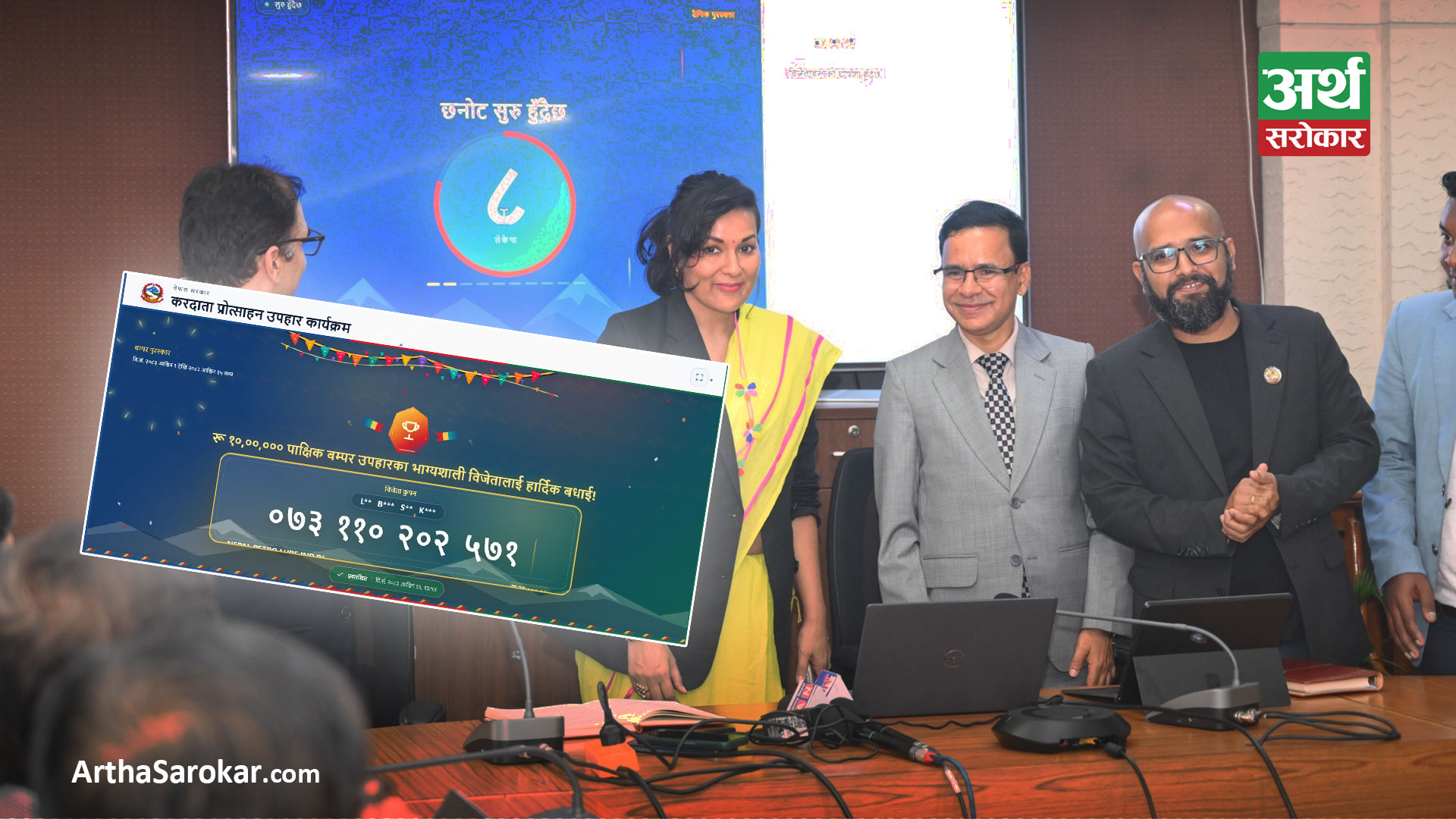





Kathmandu. The Government of Nepal has launched the ‘Taxpayer Incentive Gift Program‘ with the objective of encouraging consumers to take the bill of purchase. According to the Taxpayer Incentive Gift Program Operation Procedure, 2083 BS, consumers who purchase goods or services worth more than Rs 100 at a time across Nepal will be eligible to participate in the program. The main objective of the program is to control tax leakage, bring transactions into the formal system and motivate citizens to receive bills.
As per the working procedure, the department will select the winners through an automated system from 1st to 16th of every month. From among the participants, a daily winner and a bumper winner every 15 days will be selected. Daily winners will receive Rs. 133,334 cash prize while 15 days bumper winners will receive Rs. 1 million each.
The program seems to be a positive one. But a serious question arises – why do the citizens have to show the greed of a reward of Rs 10 lakh to get the bill according to their rights ?
It is the primary responsibility of the state to maintain discipline in the tax system and control tax evasion. If the businessmen do not show the real transaction, then the state should have an effective mechanism to control it. If the citizens do not ask for the bill, then it is the job of the state to raise awareness. But if rewards are made the main weapon rather than a long-term way to maintain discipline in the tax system, it runs the risk of developing a culture of ‘ rather than solving the problem.
The system should be stronger than the rewards
It is the right of the consumer to take the bill. Asking for a bill after purchasing an item or service is not a game of winning a prize. Citizens should get proof of the amount they have paid and businessmen have to show their business to the state transparently.
Therefore, the government needs to prioritize effective monitoring of non-billers, expansion of digital billing, capacity enhancement of tax administration, and regular action against non-billers.
If there are hundreds of transactions in the same shop every day, but the effectiveness of the tax system depends only on the activism of the customer asking for the bill, then it is not a long-term solution. The system of issuing mandatory bills for every transaction by the businessmen and effective monitoring by the state should be strengthened.
Investment or additional expense to increase prize revenue of 10 lakhs?
Another question that is important when the government runs such programs is how much the tax revenue of the state has increased compared to the amount spent on the awards?
It can be an effective investment if you spend one crore rupees on the prize and result in many times more tax collection. But if the program attracts citizens only for a short time, if the real business does not improve much and the expected increase in tax collection is not there, then it is natural to question the effectiveness of the program.
Therefore, the Ministry of Finance should regularly make public the total cost of the program, the number of participants, the number of bills issued, the number of transactions identified and the tax revenue increased from it. It helps to judge the success of the program by statistics, not emotions.
not a prize, a tax system of trust is needed
There is also a need to improve citizens’ perception of tax in Nepal. It is natural for citizens to ask, “I paid taxes, what did the state do in return?”
Confidence in tax will automatically increase if the taxpayers feel that they are getting quality health care, education, roads, drinking water, security and public services.
Therefore,instead of showing a reward of Rs 10 lakh to the citizen, it is your right to take the bill , It is the legal obligation of the businessman to give the bill and it will be very effective in the long run to build the trust that the tax you pay will be returned to the public service‘ Maybe.
Steps needed to reform the tax system
Along with the Taxpayer Incentive Gift Program, the government should give priority to the expansion of digital billing, effective monitoring and action against non-billers, simplified tax procedures and risk-based tax investigations. There is a need to bring small businesses into the formal system without unnecessary administrative burden, increase coordination of the tax system with banks and digital transactions, and develop a system where taxpayers can register, return and pay tax from home.
Similarly, the tax administration should be made transparent, technology-friendly and result-oriented, making the tax refund process simple and expeditious and the system of disclosing the details of where and how the tax collected money was spent should be strengthened. The goal of tax reform should be not just to increase penalties and revenues, but also to increase voluntary tax compliance, taxpayer trust, and transparency of transactions.
What does the international practice show?
The practice of encouraging consumers to take bills or receipts is not limited to Nepal. In Italy, there is a ‘Lotteria degli Scontrini’ (Receipt Lottery), which is linked to electronic receipts and cashless payments. The results of the weekly and monthly draws for 2026 are also being published on Italy’s official portal.
Similarly, Portugal has the ‘Fatura da Sorte’ (Lucky Invoice) program. Portugal’s official tax administration says the program was established legally in 2014 and is available in the official system of tax administration.
These examples show that the practice of using prizes or lucky draws to encourage consumers to take bills or receipts is also prevalent in other countries. But a separate impact assessment is needed to conclude how much impact such programs have had or how much additional tax revenue they have raised. In the context of Nepal too, the rewards program needs to be linked to digital billing, automated documentation of transactions, and effective tax monitoring, and its actual impact needs to be evaluated on the basis of statistics.
Respect and trust of taxpayers
Respect for citizens and trust in the state is also important in reforming the tax system. Non-cash incentives such as digital certificates, public honors, etc., can be given to taxpayers who pay taxes on time. But taxpayer confidence is built not only by rewards, but also by simplified tax procedures, fast service and the feeling that the tax they pay is being used effectively in public services.
The rewards program should also be evaluated
Prizes up to Rs 10 lakh can attract citizens to take the bill for a while. But the government should make a scientific assessment of its costs and achievements over a period of time.
How much money was spent on awards and administrative expenses? How many new bills were issued? How many additional transactions have been identified? How much more tax was collected? How many new taxpayers have joined the formal system? And most importantly, did the citizens continue to take the bill regularly even after the rewards program or only for the duration of the award? The answers to these questions should be made public with data.
The program can be continued if additional tax revenue is collected many times more than the amount spent on the prize. However, if the desired results are not achieved, it may be appropriate to change the form of the program and invest the money in digital reform of tax administration, research, monitoring and taxpayer education.
Responsibility of the citizen asking for the bill and the businessman who does not pay the bill
Both citizens and businesses have an important role to play in the tax system. Rewarding citizens for asking for bills may be an incentive for behavioural change, but it is the primary responsibility of the tax administration to ensure that businesses are issued mandatory bills for every transaction. The responsibility of tax evasion cannot be shifted to the consumer just because the citizens do not ask for the bill.
The state should strengthen the system of effective monitoring, digital billing and legal action to compel businessmen to issue bills. Citizens should create an environment to ask for bills not only in the hope of being rewarded but also as a right. Rewards may motivate citizens to ask for bills, but strong tax administrations force businesses to pay bills. Only a balance between these two aspects can create a sustainable tax culture.
The government’s side should also be understood
The program of rewarding the consumer who asks for the bill cannot be said to be completely wrong. The government’s argument might be that small economic incentives can help identify large amounts of hidden transactions, increase the culture of issuing bills, and expand tax revenue. If tax revenue increases by identifying more additional transactions than rewards and program expenses, then it can be seen as a strategic investment in revenue mobilization, not additional spending.
But where is the evidence? To conclude that the program is effective, the government should make public the data on how much money was spent on rewards and administrative expenses, how many new bills were issued, how many additional transactions were identified, how many additional taxes were collected, how many new taxpayers came into the formal system, and whether the citizens started taking the bill regularly after the program or only for the duration of the award.
If it is proven that additional tax revenue has been collected many times more than the amount spent on the prize, the program can be continued. But if the results don’t go away, it may be more effective to invest the prize money in a digital tax system, tax research, monitoring, and taxpayer education.
Conclusion
The bill incentive program cannot be completely wrong. It can play a positive role in controlling tax evasion and formalizing transactions in the short term. But the prize should not be a substitute for tax reform.
The real success of the state is not in making the citizens ask for bills in the hope of winning 10 lakhs, but in building the belief that it is their right to ask for bills, that it is the legal obligation of the businessman to pay the bill and that the tax paid will be returned to the public service.
Therefore, along with the award, digital billing, effective monitoring, action against non-billers, simple tax system, risk-based tax investigation and transparent use of tax revenue should be prioritized.
Making citizens ask for bills with the dream of winning Rs 10 lakh may be a temporary success; But the real success of sustainable tax reform is to make citizens who voluntarily ask for bills by convincing them that the country is being built with the money they pay for.
– Pharmacist Krishna Nandan Mehta



Leave your comment