

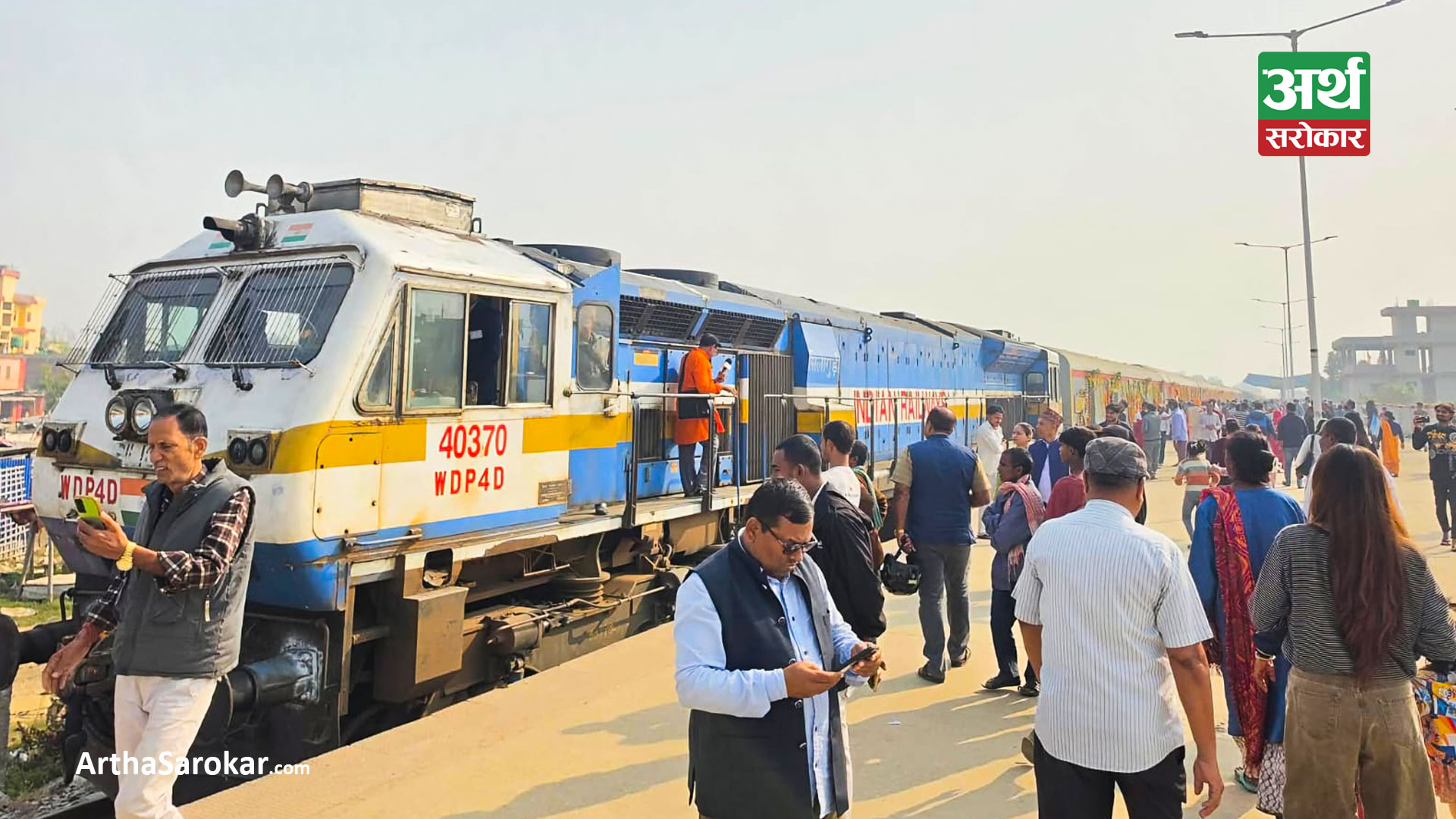

Kathmandu. Janakpurdham and Ayodhya, two historic religious cities linked to the Treta Yuga era’s Ramayana-era civilization, now have direct rail connections. The people of Janakpurdham hope that the rail service linking Janakpurdham, the birthplace of Mother Sita, and Ayodhya, the birthplace of Lord Ram, will elevate the centuries-old religious, cultural, and emotional ties between Nepal and India to new heights.
The train service between these two historic cities, linked to the love, ideals, sacrifice, and dedication of Ram and Sita described in the Ramayana, is not seen merely as a general transportation facility. It can be seen as an important means to further strengthen the shared religious civilization, cultural heritage, and people-level ties between the two countries. The rail service is believed to provide easy travel opportunities for devotees and tourists from both countries, as well as open doors to new possibilities in religious tourism, local trade, and economic activities.
Janakpurdham and Ayodhya are important pilgrimage sites in Nepal and India from the perspective of religious faith. Janakpurdham is reverently remembered as the birthplace of Goddess Sita, and Ayodhya as the birthplace of Lord Ram. The connection between these two cities is not limited to religious texts, traditions, and cultural beliefs but is deeply connected to the emotions of the citizens of both countries. Now, with the direct connection by rail, travel has become easier for devotees wishing to visit the Ramayana-era religious site.
During Prime Minister Balendra Shah’s visit to India, on Mangsir 7, the Prime Ministers of Nepal and India jointly flagged off the train service. The Sarayu–Kamala Express rail service, launched with the aim of facilitating religious travel between Janakpurdham and Ayodhya, is preparing to start commercial operations from this Saturday.
Paribar Parajuli, Managing Director of Nepal Railway Company Limited, has reached the final stage of preparations to operate the railway service commercially within a week of its inauguration. According to him, preparations are underway to open ticket booking for the commercial operation of the train arriving in Janakpurdham from Ayodhya on Saturday morning. He mentioned that discussions are underway regarding determining ticket fares, and although some technical work remains, arrangements are being made to purchase tickets directly from Janakpurdham Railway Station.
Passengers wishing to buy tickets online can book tickets through the Indian ticketing system, while those wishing to book tickets from Nepal can purchase tickets at Janakpurdham Railway Station. Parajuli, the managing director, believes this arrangement will make it easier for Nepali passengers to obtain tickets. According to him, Nepali citizens must present one of the identification cards issued by the Government of Nepal to travel by train. Passengers can purchase tickets based on their Nepali citizenship, passport, or voter ID card.
There will be a total of 17 coaches on the Janakpurdham–Ayodhya train. These include two air-conditioned second class, three air-conditioned third class, three third economy coaches, seven sleeper coaches, and two SLR coaches. Since various classes of coaches are included, passengers will be able to travel according to their needs and convenience.
According to the scheduled timetable, the train will depart from Janakpurdham to Ayodhya every Saturday and return from Ayodhya to Janakpurdham on Monday. This weekly-running service will especially facilitate pilgrims from both countries wishing to visit Janakpurdham, the birthplace of Goddess Sita, and Ayodhya, the birthplace of Lord Ram.
The train, covering a distance of approximately 604 kilometers, will connect Janakpurdham to Ayodhya through various major cities in Bihar and Uttar Pradesh. Parajuli, the managing director, stated that there will be commercial stops at places including Jaynagar, Madhubani, Sitamarhi, Raxaul, Narkatiaganj, Gorakhpur, Basti, Mankapur, and Ayodhyadham along the route. Arrangements have been made for passengers to board and alight from these locations. This is expected to benefit not only passengers from Janakpurdham and Ayodhya but also from various cities along the railway route.
Jitendra Mahaseth, former president of the Janakpurdham Industry and Commerce Association, said that the operation of the Janakpurdham-Ayodhya rail service will make a significant contribution to promoting religious tourism. According to him, establishing direct rail connectivity between the birthplace of Mother Sita and the birthplace of Lord Ram is a historic opportunity for devotees from both countries. He expressed confidence that this service will help develop Janakpurdham as an international center for religious and cultural tourism. He said that once smooth travel between religious sites connected to the Ramayana begins, the number of tourists coming to Janakpurdham from various parts of India could increase. He said that the rail service will not only help expand people-to-people relations between Nepal and India but also positively impact the agriculture, industry, trade, and tourism sectors of Madhes Province.
He mentioned that with the increase in religious tourist arrivals, local hoteliers, transport operators, and communities involved in food and handicraft businesses can directly benefit. He believes that the influx of tourists will not only expand the market for local products but also create new employment opportunities. Janakpurdham is not only a center of religious faith but also a city that holds a distinctive identity of Mithila civilization, art, culture, and tradition. The Janaki Temple, Ram Temple, marriage hall, Dhanushadham, pond, and various religious heritage sites here highlight Janakpurdham’s historical and cultural significance.
Lawyer Rajkumar Mahaseth stated that the Janakpurdham–Ayodhya rail service will increase tourist arrivals to religious tourist destinations in both countries. According to him, the rail service will help connect the Janaki Temple, Ram Temple, Dhanushadham, wedding hall, and Mithila’s unique art, culture, and heritage in Janakpurdham to the international tourism market. He expressed confidence that the rail service will further elevate Nepal’s religious, cultural, and economic ties with India. He said that if tourists visiting Janakpurdham can experience Mithila’s art, culture, cuisine, and traditional lifestyle along with visiting religious sites, the tourism potential will expand further.
Mithila paintings, folk songs, folk dances, traditional handicrafts, wedding ceremonies, and various cultural festivals are important tourist attractions in Janakpurdham. He stated that with the increase in tourist traffic by rail, it is expected that these original heritage promotions and market expansion will also be supported. With the increase in the number of religious tourists, there is a possibility of economic activity expanding in Janakpurdham’s hotel and accommodation businesses, restaurants, transportation, handicrafts, local products, and tourism guides. Legal practitioner Mahaseth stated that if tourists’ stays can be extended, local businessmen could directly benefit.
Religious tour packages, local cultural programs, Mithila cuisine, handicraft exhibitions, and visits to tourist destinations can be arranged targeting tourists arriving via rail services. He stated that this could not only organize the tourism business but also create employment opportunities for local youth. Legal practitioner Mahaseth said that with the increase in tourist arrivals, local hoteliers, transport operators, tourist guide operators, and communities involved in the handicraft sector could directly benefit. For this, he suggested improvements in tourist-friendly infrastructure, cleanliness, accommodation, security, information, and transportation management.
Janakpurdham and Ayodhya are two important religious centers related to the Ramayana. The establishment of direct rail connectivity between these two cities is expected to help make the concept of the Ramayana circuit more effective. During Vivah Panchami, Ram Navami, Janaki Navami, and other religious festivals, large numbers of devotees from various parts of India have come to Janakpurdham. Similarly, Ayodhya also sees the arrival of domestic and foreign tourists for various religious and cultural activities.
With the operation of the train service between the two cities, pilgrims will have the opportunity to visit both religious sites in a single journey. Rights activist Sijendra Sada said this will not only facilitate religious travel but also increase the possibility of expanding cooperation and contacts between religious and cultural institutions of both countries. He said that if other religious and historical sites related to the Ramayana can also be connected on a single tourism route, the scope of religious tourism between Nepal and India could expand further.
Civil society leader Rekha Jhal said that despite long-standing initiatives, the rail service that could not be operated is now a positive achievement in the implementation phase. He emphasized that necessary policy decisions, administrative coordination, and infrastructure management must be made between the governments of both countries to make the rail service regular and effective. According to him, while the operation of the rail service is a significant achievement, its long-term success will depend on regular operations, passenger safety, smooth ticketing arrangements, and effective management. He stated that cooperation between the government and the private sector is necessary to create an environment where local communities can benefit from religious tourism.
Currently, regular train services run from Jaynagar, India, through Janakpurdham in Nepal, to Bijalpura in Mahottari. Based on this rail network, a commercial special Janakpurdham–Ayodhya rail service is being launched. Janakpurdham is regarded as the birthplace of Mother Sita, and Ayodhya is regarded as the birthplace of Lord Ram. With direct rail connectivity established between these two historic cities, it is expected that new opportunities for religious tourism will open up, and the connection between religious and cultural destinations connected to the Ramayana will become even stronger.
Local businessman Ambuprasad Sah believes that the new rail service will not only facilitate tourist travel between these two historic centers of devotion and culture, but will also give new momentum to local economic activities and people-to-people relations between Nepal and India. If religious faith can be linked with tourism, trade, and economic prosperity, Janakpurdham will have the opportunity to establish a greater identity in the international tourism market. For this, it is necessary to make rail services regular and reliable, ensure smooth passenger movement, improve tourist infrastructure, and maintain effective coordination between the relevant authorities of both countries, Sah said.




Leave your comment